


How to Design an AI-to-Human Handoff That Keeps Every Claim Moving
How to set decision boundaries, package context, and hand the claim back to automation after the adjuster decides.
8 min read
Ask a claims leader how their automation program is going and you’ll usually get an automation rate. Ask what happens at the moment automation stops, and the answer gets vague.
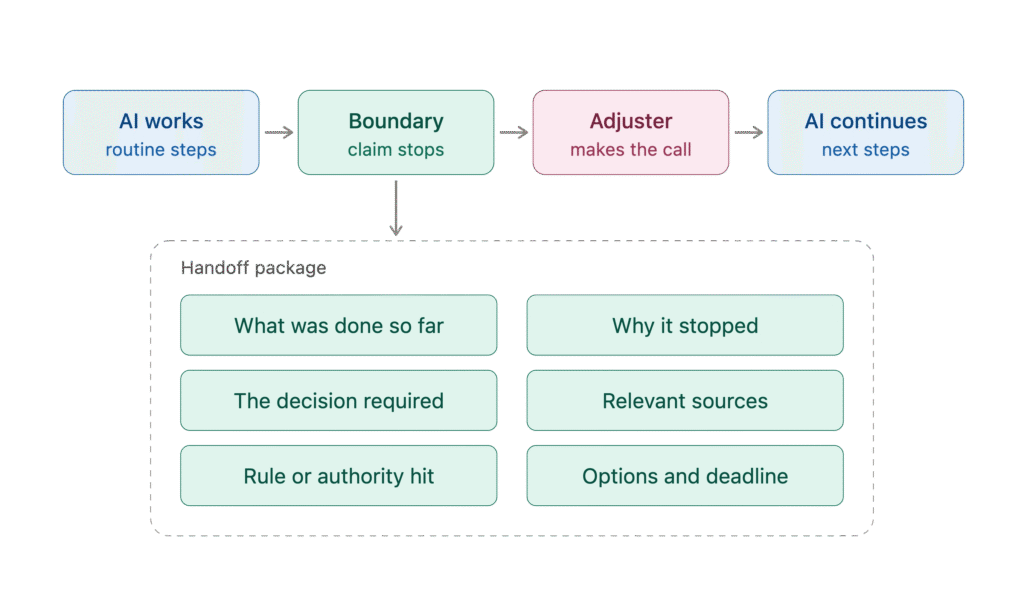
That moment is the human handoff, and it decides whether agentic AI reduces work or adds it. A well-designed handoff in claims automation does three things: it stops the AI at a defined decision boundary, gives the adjuster the evidence and the exact question or reason it stopped, and then picks the claim back up once the decision is recorded. Handoffs that skip any of those three steps push the reconstruction work back onto the adjuster, and the operation loses most of what the automation earned.
What you will learn:
- Where to set decision boundaries so the AI stops at the right moment, not at every moment
- The six elements every decision-ready handoff should contain
- How the claim continues automatically after the adjuster decides
- The controls that let you raise automation without raising risk
- How to test whether a handoff is actually finished
Key definitions
Three terms do most of the work in handoff design. Getting them precise makes the rest of the operating model easier to specify.
Term | Definition |
|---|---|
Decision boundary | The defined condition at which agentic AI stops executing and brings a person into the claim, based on authority, confidence, sensitivity, or material exception. |
Decision-ready handoff | A structured package containing what changed, the relevant facts with their sources, the actions already completed, the rule or authority involved, and the exact decision required. |
Human-in-the-loop | An ownership model where AI prepares the work and a person decides or approves, with visible sources and a recorded override path. |
What is a decision-ready handoff in claims automation?
A decision-ready handoff is the structured package agentic AI gives an adjuster when it reaches a decision boundary. It contains the facts, their sources, the actions already completed, and the exact decision required, so the adjuster can decide without rebuilding the case.
The key word in “decision-ready handoff” is “ready” – ready for an adjuster to take over. A notification that simply says a claim needs attention creates another interruption. What should arrive ready is everything the adjuster needs to make the call.
A well set up handoff does that when it answers four questions before the adjuster opens a single system:
- What has been done on this claim so far, and by whom or by which agent
- Why it stopped here, meaning the boundary, rule, or threshold that triggered the escalation
- What decision is being asked for, stated specifically enough to act on
- Which sources sit behind that question: the documents, images, policy language, and correspondence relevant to this decision
If the escalations answer none of the four, so in fact they only flag a claim as needing attention and leave the adjuster to reassemble the rest. When the adjuster has to go find the estimate, re-read the policy, and work out what the AI already did, the claim stalls at exactly the point it was supposed to speed up.
This design choice is arriving fast. Celent’s annual survey on generative AI in insurance found 22% of insurers plan to have an agentic AI solution in place by year-end 2026, with claims among the leading functions. Every one of those deployments will produce handoffs, whether or not anyone designed them.
Where to set the decision boundary in a claim
A decision boundary is the condition that stops automation and brings in an adjuster or supervisor. Set it on authority, confidence, sensitivity, and material exception, and state each one as a testable rule before you automate anything.
Rule-based automation runs until it meets an exception, then stops and leaves the adjuster to reconstruct what happened. Agentic AI can be designed to do something different: reach the boundary, package the situation, and wait for a decision it knows it needs.
You decide where the claim stops, and in a P&C file that list gets specific fast. Coverage determinations. Reserve movements past a set threshold. Any denial. A claimant who becomes represented, a file that turns into litigation or a complaint, or a claim that trips a pattern you asked the system to watch for.
The boundaries themselves are not exotic. Most claims operations already have them written into authority tables and SOPs.
Boundary | Typical trigger |
|---|---|
Authority | Payment or settlement above the handler’s limit |
Confidence | Low-confidence output, or incomplete evidence after a defined number of attempts |
Conflict | Contradictory facts, or unclear policy application |
Sensitivity | Potential fraud, litigation, complaint, or regulatory exposure |
Empathy | Policyholder asks for a person, or the communication requires judgment |
Exception | A material departure from the expected claim path |
Set that way, the claim takes on a rhythm. Between boundaries it advances on its own: documents arrive and get indexed, the summary stays current, records are structured, inconsistencies get flagged. At a boundary it holds and waits for a person, with the question that needs answering stated at the top. Once the decision is recorded, it moves again to the next boundary.
The reason to be precise here is scale. McKinsey estimates that by 2030 more than half of current claims activities could be replaced by automation. At that volume, an operation with vague boundaries produces one of two failure states: adjusters reviewing routine work they shouldn’t see, or automation acting past the point where someone should have signed off. Both are expensive, and the second one is the kind an examiner asks about.
If your team disagrees about what the correct next step should be, AI won’t resolve that ambiguity. Standardize the rule, the authority, or the handoff first. Then automate it.
What belongs in a decision-ready handoff
A decision-ready handoff contains six things: what changed, the relevant facts with their sources, what the AI already completed, the rule or authority involved, the exact decision required, and the available options with any deadline.
The four questions described above expand into six concrete elements when you specify them for a workflow. The test for all six is time-to-decision. If the adjuster has to rebuild the story before they can act, the automation hasn’t finished its job.
That rebuilding cost is measurable. Harvard Business Review’s study of 137 workers across three Fortune 500 companies found people toggle between applications roughly 1,200 times a day, spending just under four hours a week, about 9% of working time, simply reorienting after each switch. Claims work sits at the heavy end of that pattern: policy system, document store, email, estimating platform, payment queue. A handoff that arrives as a bare alert forces the adjuster back through all of it. A handoff that arrives complete removes the tour.
Six elements make a handoff complete:
- What changed, and why the claim needs attention now.
- The relevant facts, with the source of each, so the adjuster can check the evidence rather than hunt for it.
- The actions the AI already completed, so nothing gets repeated.
- The rule, policy, threshold, or authority involved, so the escalation makes sense.
- The exact decision required: what the adjuster is being asked to approve, choose, or determine.
- The options available, plus any deadline or service risk attached to waiting.
Gil Nechushtai, Chief Product Officer at Five Sigma, frames the design question this way: “we constantly ask: what can be automated, and what should be left to human judgment?” The handoff is where that answer becomes operational. Everything above the boundary is preparation. Everything at the boundary is judgment.
See Clive AI in Action.
See what a decision-ready handoff looks like on your own claim types.
How the claim continues after the adjuster decides
After the decision is made by a human adjuster, agentic AI should capture the authorized next step and continue the downstream routine work: documentation, communication, status updates, follow-up, and monitoring. The adjuster should never have to restart the process by hand.
This is the half of the handoff most implementations drop. The AI escalates well, the adjuster decides, and then the claim lands back in a manual queue. The gain from the first half is spent re-entering the second.
Here’s what a complete round trip looks like on a common file: an estimate and supporting documents arrive by email.
Step | Owner | What happens |
|---|---|---|
1. Receive and organize | AI | Reads the email, classifies attachments, connects them to the correct claim, extracts key details |
2. Check completeness | AI | Compares the submission against required information, sends an approved request for what’s missing |
3. Monitor and follow up | AI | Tracks the response and runs reminders without adding a diary task |
4. Escalate the exception | AI | Documents indicate possible pre-existing damage; packages facts, images, prior actions, and the specific question |
5. Apply judgment | Adjuster | Reviews the prepared evidence, determines scope, records the decision |
6. Continue the claim | AI | Documents the action, sends the approved communication, updates status, sets the next follow-up, monitors completion |
The adjuster touches step 5. Five other steps happen automatically around them.
That distinction matters more as capacity tightens. The US Bureau of Labor Statistics projects employment of claims adjusters, appraisers, examiners, and investigators to decline 5% between 2024 and 2034, with about 21,600 openings a year coming almost entirely from replacement rather than growth. Operations aren’t hiring their way through rising volume. The available lever is how much of the surrounding work an adjuster still has to carry per decision.
The controls that make handoffs safe to scale
Six controls keep handoffs governed as autonomy rises: permission boundaries, confidence thresholds, traceability, quality sampling, supervisor visibility, and closed-loop learning from overrides.
Control moves to the right level. Sampling, exception rules, and audit trails replace checking every routine action on every claim.
- Permission boundaries. Define which actions the AI can take, which it can prepare, and which it can only recommend.
- Confidence thresholds. Route uncertain or conflicting outputs to a person before anything acts on them.
- Traceability. Keep a clear record of source data, AI actions, human decisions, and overrides.
- Quality sampling. Review a representative sample of automated work, not only the exceptions.
- Supervisor visibility. Show where work is delayed, where exceptions cluster, and where rules need adjusting.
- Closed-loop learning. Use overrides and corrections to improve the rules, the data quality, and the training.
Regulators are asking for most of this already. More than 20 US states and the District of Columbia have adopted the NAIC Model Bulletin on the Use of Artificial Intelligence Systems by Insurers, which expects written governance, documented oversight, and records an examiner can inspect. A traceable handoff produces that evidence as a by-product of the workflow, which is a cheaper way to satisfy it than assembling documentation after the fact.
An override is not automatically a failure. It may point to a data issue, an unclear rule, a new claim pattern, or a coaching need. Segment overrides by reason, then decide whether to change the workflow, the rule, the data, or the training.
“From the moment a customer lodges a claim through to final settlement, our claims team is supported by AI to streamline the claim process and reduce delays, while ensuring every decision is overseen by experienced claims professionals.”
Dean van Es, CEO, Fast Cover
The design test for any handoff
Can the adjuster understand the issue, make the decision, and return the claim to automation without opening several systems or reconstructing the history? If not, the handoff is incomplete.
Run this test on one real claim before you scale the pattern. Pick a recent escalation, put the handoff package in front of an experienced adjuster, and time how long it takes them to reach a decision they’re comfortable recording.
If they open a second system, the facts weren’t packaged. If they ask what the AI already did, the completed actions weren’t shown. If they hesitate over what’s being asked, the decision request wasn’t specific.
Read the full framework: Adjuster + Agentic AI, Building a Top-Performing Claims Team
The full six-step framework covers task mapping, ownership, handoff design, queue redesign, adoption, and measurement.
Where Clive AI picks the claim back up
Clive™, Five Sigma’s Multi-Agent AI Claims Expert, runs routine work along the claim lifecycle, stops at the boundaries you configure, hands the adjuster a prepared decision, and continues the downstream work once the decision is recorded.
Change what arrives on that screen and you change the job. Instead of working a diary of reminders that mostly resolve to nothing moved, the adjuster opens a queue of claims that need a decision now. Read, decide, record it, next. Automation picks the claim up from that decision and carries it to the next boundary.
Five Sigma’s work has moved past automating the processing of a claim, toward making it easy for an adjuster to navigate the claims in their queue. Instead of working a diary of reminders that mostly resolve to nothing moved, the adjuster opens a queue of claims that need a decision today, already read, already summarized, with the gaps chased and the inconsistencies surfaced. Adjusters go through the escalation details, decide, record the decision, and move to the next one. Automation picks the claim up from that decision and carries it to the next boundary.
Five Sigma reports that at Resorts World Las Vegas this produced a 33% boost in adjuster productivity and $150K a month in cost savings, without adding headcount. The adjusters still made the calls.
See AI claims automation in action
See how Clive helps claims teams automate repetitive work and measure the impact.
Key takeaways
- A human handoff in claims automation is a design decision, not a fallback. Define the decision boundary before you automate the surrounding work.
- Set boundaries on authority, confidence, conflict, sensitivity, empathy, and material exception, and write each as a testable rule.
- A decision-ready handoff contains six elements: what changed, sourced facts, completed actions, the rule or authority involved, the exact decision required, and the options with any deadline.
- Automation has to resume after the decision. If the adjuster restarts the process manually, the operation loses most of the gain.
- Six controls make rising autonomy governable: permissions, confidence thresholds, traceability, quality sampling, supervisor visibility, and closed-loop learning from overrides.
- The design test is whether an adjuster can decide and return the claim to automation without opening several systems.
Frequently asked questions
What is a human handoff in claims automation?
It’s the moment agentic AI stops executing and brings an adjuster into the claim to decide. A well-designed handoff includes the facts, their sources, the actions already completed, and the exact decision required, so the adjuster can act without reconstructing the file.
When should AI escalate a claim to a human adjuster?
At defined decision boundaries: payments or settlements above authority, low confidence or incomplete evidence, conflicting facts, potential fraud or litigation, a policyholder request for a person, or a material exception to the expected claim path.
What should a decision-ready handoff include?
Six things: what changed and why the claim needs attention, the relevant facts with the source of each, the actions the AI already completed, the rule or authority involved, the exact decision required, and the available options with any deadline.
What happens after the adjuster makes the decision?
Agentic AI captures the authorized next step and continues the routine downstream work: documentation, the approved communication, status updates, the next follow-up, and monitoring. The adjuster shouldn’t have to restart the process manually.
How do you know if a handoff is well designed?
Apply the design test. If an adjuster can understand the issue, decide, and return the claim to automation without opening several systems or rebuilding the history, the handoff works. If not, it’s incomplete.
What should you look for in an agentic AI tool for claims management?
Configurable AI autonomy boundaries against your own delegated authority, decision-ready handoffs, automation that resumes after the adjuster decides, and a traceable record of AI actions, human decisions, and overrides. Five Sigma builds its claims platform around that pattern.
Does agentic AI replace claims adjusters?
Adjusters keep coverage determinations, denials, reserve movements above threshold, represented and litigated files, and any judgment call. Agentic AI handles the work around those decisions, so more of the adjuster’s day goes to deciding.

Tirtza Bensoussan
Related resources
- Guide: Adjuster + Agentic AI: Building a Top-Performing Claims Team
- Blog: Agentic AI Claims Guardrails: How Much Autonomy Can AI Have
- Blog: The Agentic Era of Claims: The System of Record Becomes the System of Action
- Blog: From AI-Assisted to Agentic AI Claims: Where the Adjuster’s Role Moves
- Case Study: How Resorts World Las Vegas Cut $150K a Month in Claims Costs with Clive AI